
A Zepbound Shot Day Checklist You Can Actually Repeat Every Week

✓ Free to download
Use a repeatable Zepbound shot day checklist to stay organized, reduce decision fatigue, and make weekly injections easier to manage.
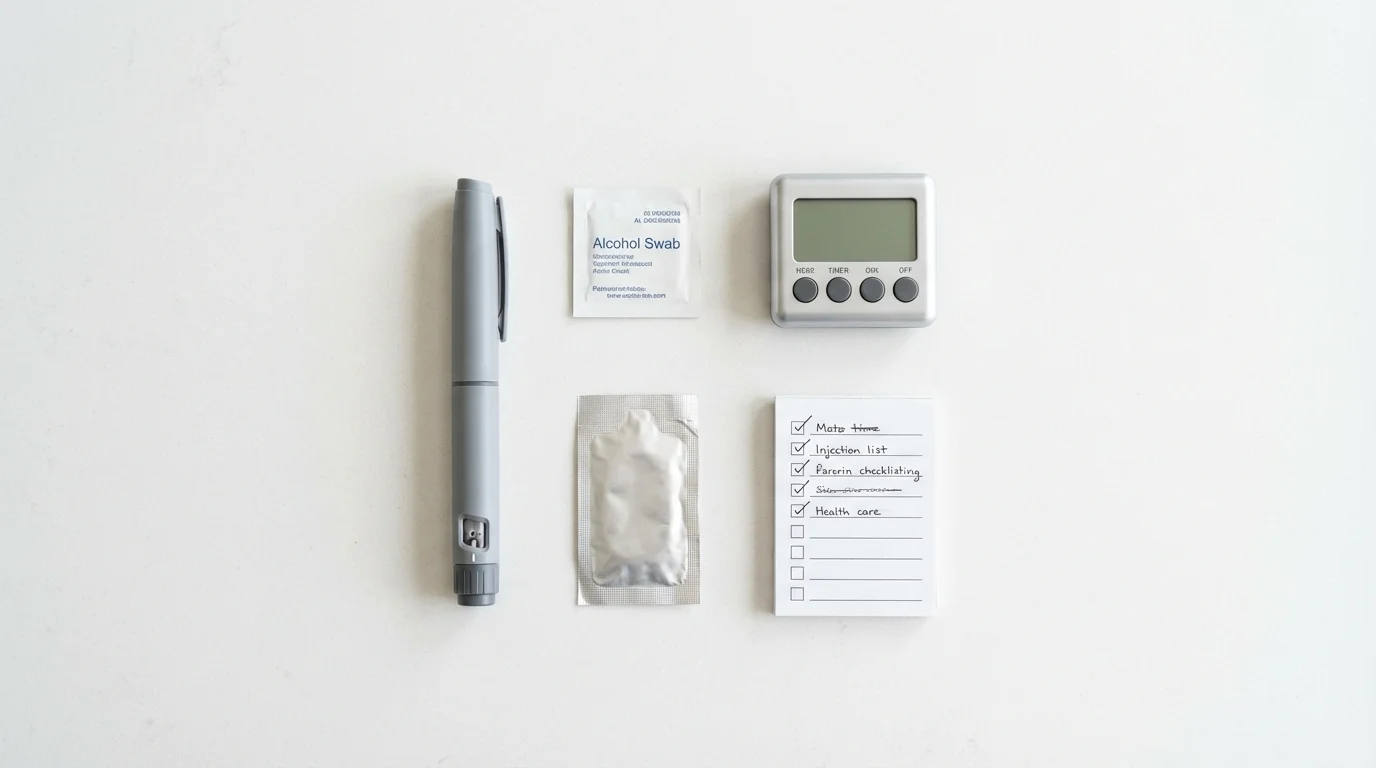
The best injection-day routine is the one you can repeat without friction. A checklist helps remove last-minute uncertainty and makes it easier to stay consistent week after week.
For most people on Zepbound, the injection itself takes less than a minute. The surrounding routine — preparation, logging, site choice, and follow-up — is what makes the experience smooth or stressful. A clear, repeatable system reduces that stress to almost nothing.
Why a consistent routine matters on Zepbound
Tirzepatide (the active ingredient in Zepbound) works by activating both GLP-1 and GIP receptors. It is a once-weekly injection, which means missing a dose, taking it at an inconsistent time, or handling it incorrectly can affect both your results and your side effect experience.
A consistent routine:
- Reduces the chance of missed or late doses
- Makes side effect patterns easier to identify and manage
- Lowers anxiety around injection technique
- Creates a natural moment to track how the week went
People who treat injection day as a small ritual — rather than something to get through — tend to stay more consistent over the months that matter.
Before shot day: what to have ready
Set yourself up the day before or the morning of injection day. Do not leave it to the last minute when you are tired or rushed.
Check your supply:
- Confirm you have your Zepbound pen (not expired, not frozen)
- Check that the liquid is colourless to slightly yellow — if it looks cloudy or has particles, or the pen is damaged or was dropped on a hard surface, do not use it
- Make sure you have alcohol swabs available
Check your current dose:
- Confirm the dose your doctor prescribed for this week
- If you are in a dose escalation phase, confirm you are on the right tier
- Do not assume the dose from last week is the same as this week
Review the previous week briefly:
- How was appetite control across the seven days?
- Did any side effects appear, and when?
- Was there anything unusual — travel, illness, disrupted sleep — that might explain how the week went?
This two-minute review becomes more valuable over time. It is your raw material for spotting patterns.
The steps below are for the single-dose Zepbound pen. The KwikPen (which needs a new pen needle for each dose) and vials are used differently, so follow the Instructions for Use that came with your device.
Suggested shot day sequence
A repeatable order lowers decision fatigue. Follow the same steps every time.
Step 1: Remove the pen from the fridge
Take your Zepbound pen out of the refrigerator. Lilly's instructions say it is not necessary to warm it to room temperature, although some people find a few minutes out of the fridge more comfortable. Do not try to warm it under hot water or in a microwave. Wash your hands.
Step 2: Choose your injection site
Rotate between the abdomen, the thigh and (if someone else is injecting) the back of the upper arm. Rotate the site each week; you can use the same area if you choose a different spot within it. Keep a note of last week's site so you are not injecting into the same area twice in a row.
Abdomen: Stay at least 2 inches (5 cm) away from the navel. The lower abdomen tends to be easier to manage solo.
Upper thigh: The outer thigh, halfway between knee and hip, works well when seated.
Upper arm: Lilly's instructions say the back of the upper arm should be injected by another person, such as a partner or caregiver.
Avoid areas with bruising, scarring, stretch marks, or any skin that is irritated.
Step 3: Prepare the site
Clean the chosen area with an alcohol swab. Let it dry fully — at least 10–15 seconds. Injecting into wet skin stings more.
Step 4: Inject
- Make sure the pen is locked, then pull the gray base cap straight off (do not put it back on, and do not touch the needle)
- Place the clear base flat against the skin at the chosen site, then unlock the pen by turning the lock ring
- Press and hold the purple injection button for up to 10 seconds
- The first click means the injection has started; keep the pen on your skin until the second click, which means it is complete
- Check that the gray plunger is visible, then remove the pen and press gently with a cotton ball or gauze if needed — do not rub
Step 5: Dispose of the pen
Place the used pen directly into a sharps disposal container. Do not put the base cap back on. Do not throw pens in regular household rubbish.
Step 6: Log the injection
Record the injection immediately. Note:
- Date and time
- Dose
- Injection site used
- Any immediate reaction at the site
This takes 30 seconds and saves a lot of guesswork later.
Step 7: Set your next reminder
Set a reminder for exactly 7 days from today. Do not rely on memory.
What to track across the week after injection
Injection day is also the right time to plan what you will watch for over the coming days.
Appetite changes
Some people notice appetite is lowest in the first few days after injection and that hunger gradually returns toward the end of the week; others notice little change across the week. Tracking this pattern helps you plan meals and identify whether appetite control is consistent across doses.
Side effect window
Nausea, if it occurs, may appear in the days after the injection, and the timing varies from person to person. Constipation tends to build over several days. Note when symptoms arrive and when they resolve. This pattern is your guide — if nausea always peaks on day 2, you can prepare for it.
Hydration and meal timing
Zepbound slows gastric emptying. Eating smaller, more frequent meals and staying well hydrated helps many people with nausea. Track your hydration and note whether eating habits affected how you felt.
Energy levels
Some people feel a slight energy dip in the 24–48 hours after injection. Others feel fine. Note what happens for you.
Common injection day issues and how to handle them
The pen does not seem to have injected fully. Keep the clear base flat against the skin until you hear the second click. Your dose was delivered if the gray plunger is visible. If you do not see the gray plunger or are unsure whether a dose delivered, do not take another injection — contact Lilly (1-800-545-5979), your pharmacist or your doctor for instructions.
There is bleeding or bruising at the site. A small amount of bleeding is normal. Press gently with a clean swab. If bruising is persistent or spreading, note the site and avoid that area for the next two weeks.
The injection site is red and swollen. Mild redness immediately after injection is normal. If redness, swelling, or warmth persists beyond 24 hours or is spreading, contact your healthcare provider.
You are feeling very nauseated after the injection. Do not eat a large meal immediately before or after your injection. Keep meals small and low-fat in the 24 hours following the shot. Ginger tea, peppermint, and staying upright after eating can help. If nausea is severe and persistent, talk to your doctor — dose adjustment may be needed. Get urgent medical help if you cannot keep fluids down, have severe abdominal pain that will not go away (it may spread to your back), or have swelling of the face or throat or trouble breathing.
Monthly injection day review
Once a month, do a slightly more thorough review:
- How has average appetite control changed across the month?
- Are side effects improving, stable, or getting worse?
- Has weight trend been consistent with appetite and dose changes?
- Is there anything to discuss with your doctor at your next check-in?
This monthly review takes 10 minutes and makes clinical check-ins far more productive. Instead of trying to remember a month of experience from memory, you have a structured record.
Keeping your routine connected
If your shot log, symptom notes, and weight trend all live in different places, the routine gets harder to maintain. A single tracking flow — where injection logs, side effect notes, and weekly weight sit together — makes it much easier to see the full picture.
Weight Easy tracks dose changes, weekly injection logs, symptom patterns, and weight trends in one place. Connecting your shot day checklist to a consistent tracking system is what turns good intentions into lasting habits.
Final takeaway
A good Zepbound shot day routine is simple, visible, and easy to repeat. The preparation takes a few minutes, the injection takes under a minute, and the logging takes 30 seconds. What you build over weeks and months is a clear record of how your body responds — which is genuinely useful information for you and your doctor.
The less thinking your routine requires, the more likely you are to stay consistent over the long term.
If you use oral contraceptives, ask your doctor about adding a barrier method for 4 weeks after starting Zepbound and after each dose increase. Tell your doctor or surgical team you take Zepbound before any procedure with anaesthesia or sedation.
Consult your healthcare provider before starting, adjusting, or stopping any medication.
Sources
- Ozempic prescribing information: https://www.accessdata.fda.gov/drugsatfda_docs/label/2025/209637s025lbl.pdf
- Wegovy prescribing information: https://www.accessdata.fda.gov/drugsatfda_docs/label/2024/215256s011lbl.pdf
- Mounjaro prescribing information: https://www.accessdata.fda.gov/drugsatfda_docs/label/2025/215866s034lbl.pdf
- Zepbound prescribing information (revised August 2026): https://pi.lilly.com/us/zepbound-uspi.pdf
- Zepbound single-dose pen Instructions for Use, Eli Lilly: https://pi.lilly.com/us/zepbound-pen-us-ifu.pdf
Related Articles
-
Zepbound (tirzepatide) Prescribing Information — Eli Lilly and Company
-
FDA approval of tirzepatide for chronic weight management: drugs.com/history/zepbound.html
-
Jastreboff AM, et al. Tirzepatide Once Weekly for the Treatment of Obesity. N Engl J Med. 2022;387:205–216
-
Eli Lilly patient resources: zepbound.lilly.com
FAQ
What day of the week should I take Zepbound?
You can choose any day that fits your routine. Many people pick a day when they are at home and relaxed — a Monday or Saturday works well. What matters most is consistency: take it on the same day each week.
Can I change my Zepbound injection day?
Yes, but with care. If you need to shift your day, allow at least 3 days (72 hours) between your last injection and your new day. Do not take two doses within 3 days of each other. Talk to your doctor or pharmacist if you are unsure.
What do I do if I miss a Zepbound injection day?
If it has been 4 days (96 hours) or less since your missed dose, take it as soon as possible. If more than 4 days have passed, skip the missed dose and take your next dose on your regular day. Do not take two doses to make up for it.
Where can I inject Zepbound?
Zepbound is injected subcutaneously (under the skin) into the abdomen or thigh, or into the back of the upper arm if another person gives the injection. Rotate the injection site each week. Avoid injecting into the same spot twice in a row.
Does Zepbound need to be refrigerated?
Yes. Store Zepbound in the refrigerator at 36°F to 46°F (2°C to 8°C) in its original carton. If needed, a single-dose pen can be kept at room temperature up to 86°F (30°C) for a total of 21 days; KwikPens and multi-dose vials have a 30-day limit (and an opened KwikPen or vial is thrown away after 30 days or 4 weekly doses, whichever comes first). You do not need to warm the pen before injecting. Do not freeze it, and do not use it if it has been frozen.
Can I inject Zepbound through clothing?
No. Always inject into bare skin. Wash your hands first; many people also clean the site with an alcohol swab and let it dry before injecting.
Written by
Dietician / Nutritionist
Health Content Writer
Ankita Verma is a Dietician / Nutritionist professional who contributes evidence-informed health and wellness content for Weight Easy.
View profile →Reviewed by
Dietician / Nutritionist, Phd scholar
Senior Medical Reviewer
Nishat Anjum is a Dietician / Nutritionist, Phd scholar professional who reviews Weight Easy health content for medical and editorial accuracy.
View profile →